I style spaces. I arrange objects. I design things, direct shoots, obsess over shadows, and occasionally have existential crises about whether a single bowl is too much or not enough. My title changes depending on the day—or the client. Sometimes I’m a stylist. Sometimes a designer. Sometimes I get introduced as a creative director, which sounds nice, but often just means I’m the one deciding how the curtain should fall.
The common thread—the thing that has stayed constant—is a desire to create spaces and images that feel lived-in, human, and quietly magnetic. Not perfect. Not polished. But full of intention. Because intention drives results. Whether it’s a product launch, a catalog campaign, or a retail rebrand, when a space or image feels intentional, it performs—connecting emotionally and commercially.
With so much inspiration at our fingertips, have we actually stopped feeling inspired?
Lately, though, I’ve been feeling something shift. Maybe you have too: We’re surrounded by beauty. It’s never been easier to find it—on our phones, in our inboxes, on Pinterest boards full of travertine and low-slung furniture. And yet, I find myself wondering: With so much inspiration at our fingertips, have we actually stopped feeling inspired?
There was a time when finding inspiration felt like a real activity. An adventure, even: You’d spend an afternoon flipping through old design books, or slowly tearing pages from a magazine—carefully, with a metal ruler, like you were doing surgery.
You’d walk through a flea market and spot something—a brass object, a lumpy ceramic—and feel your brain light up. Or you’d travel and come back with a single, perfect detail etched in your mind: the way linen curtains moved in a Greek rental. The color of a stone floor in a Milanese apartment. Inspiration took time. It arrived on its own schedule. And maybe because of that, it felt more sacred.
Now? Inspiration finds us. It shows up uninvited. It floods our screens at all hours. Before I’ve brushed my teeth, I’ve already seen seven perfectly styled vignettes, three trending palettes, and a new Scandinavian brand that I apparently need to know about.
And don’t get me wrong—I save things, I screenshot, I’m not above a moodboard. But I’ve started to ask myself: When does inspiration cross the line into imitation? When do all those saved images start to cancel each other out?
Because here’s the thing: the more we scroll, the harder it becomes to tell where someone else’s eye ends and our own begins. The algorithm gets smarter. And our instincts—if we’re not careful—get quieter.
It’s not that the images aren’t inspiring; it’s that they come so fast, and in such quantity, that we don’t have time to metabolize them. So the question becomes: how do we make space again? How do we slow the scroll, so we can actually see?
We’re building a new visual language: one that speaks directly to how brands connect with consumers.
For a long time, styling was seen as decoration. The garnish. A pillow fluff, a branch trim, a well-placed lemon. But to me, styling is punctuation. Sometimes it’s the period at the end of a sentence. Sometimes it’s the whole damn paragraph. It’s the thing that makes a space feel intentional—not staged. Alive—not static.
And yet, styling doesn’t exist in a vacuum anymore. I’ve been hired to “style” a shoot and ended up: Rearranging the entire floor plan, rewriting the messaging, diplomatically suggesting that maybe we don’t need that oversized fiddle-leaf fig in the corner…
So what was I doing? Styling? Designing? Directing? Yes. All of the above. And sometimes also playing therapist, mediator, or motivational speaker to a slightly frazzled creative team. The roles bleed together.
There was a time when I wanted clear job descriptions. I wanted a lane, a label, a sense of where I started and where I stopped. But over time, I’ve learned that the blur isn’t a breakdown—it’s a breakthrough. We’re not losing clarity. We’re gaining fluency. We’re building a new visual language: one that speaks directly to how brands connect with consumers. In my work with Beni Rugs, Zara Home, Crate & Barrel, West Elm, and Audo, that fluency has helped turn quiet creative choices into bold brand moments.
Whether I’m styling, designing, consulting, or art directing—it all comes from the same impulse: to tell a story, to shape an experience, to guide a feeling from concept to reality.
I've had a complicated relationship with the word “stylist.” It’s the title that opened doors for me, and the one I’m most often called—but sometimes, it feels like a box. Like shorthand for something much smaller than the work actually is. Because styling isn’t just a task—it’s a lens. It’s not what I am, but it’s one of the most nuanced tools I use to shape emotion, story, and space.
Let’s talk about the algorithm for a second. Our ever-present, aesthetically savvy overlord. It’s trained to show us what works. What’s trending. What everyone else is saving. But what it doesn’t show us is what’s true. It doesn’t know what we feel, what we notice. The algorithm rewards speed. Familiarity. Repetition. Which is why you start to see the same gestures, the same tones, the same surfaces, again and again.
To protect my intuition, I’ve learned to step away. I take long walks. I sit in silence. I revisit the same five objects on my shelf and see what they have to say that day. I sketch. I write. I let boredom in—because boredom is where intuition gets louder.
Stillness gets a bad rap in our culture. It’s often mistaken for laziness, for indecision, for not doing enough (especially in the age of social media, where movement equals momentum and productivity is always performative). But in my world, stillness is a strategy—a powerful one. In content-saturated markets, stillness isn’t passive—it’s a competitive edge. It invites pause. It holds attention.
So where does that leave us? What is a stylist now?
We’re not just translators anymore. We’re brand storytellers. Documentarians. Interpreters of atmosphere in a commercial world. Most people will never step foot into the rooms we style. They won’t feel the air, smell the flowers, hear the floor creak. They’ll experience it once, through one image. That image has to hold the entire mood, to speak on behalf of everything the space can’t say out loud. And so our job becomes translating space into feeling. We make the intangible visible.
I stopped trying to match the reference, and started trying to match the feeling behind it.
In my time in this industry, I’ve noticed a shift: The briefs are looser now, the roles more fluid. And honestly, the best projects—the ones that hum with something real—are usually the ones where the creative trust is wide open.
One of my mentors, Robin Standefer, once told me, “The moodboard is light because I want to create something that doesn’t exist yet.”
That line cracked something open for me. I stopped trying to match the reference, and started trying to match the feeling behind it. I began pulling inspiration from stranger places: old paintings, foreign films, a puddle of light on the subway wall.
Because here’s the thing: what we make takes time. It takes hours of looking, shifting, second-guessing. It takes presence. Energy. Patience. And then—poof—it’s out in the world, consumed in seconds. Saved. Liked. Forgotten by lunch.
There’s no shame in wanting to be seen. We all want that. But the most meaningful work I’ve made—the work that stays with me—has come from a quieter place. It’s come from intuition, from stillness, from the joy of making something just because it feels right.
The algorithm will always want more—but the good work? It wants meaning. And meaning, in this business, is the difference between noise and resonance.
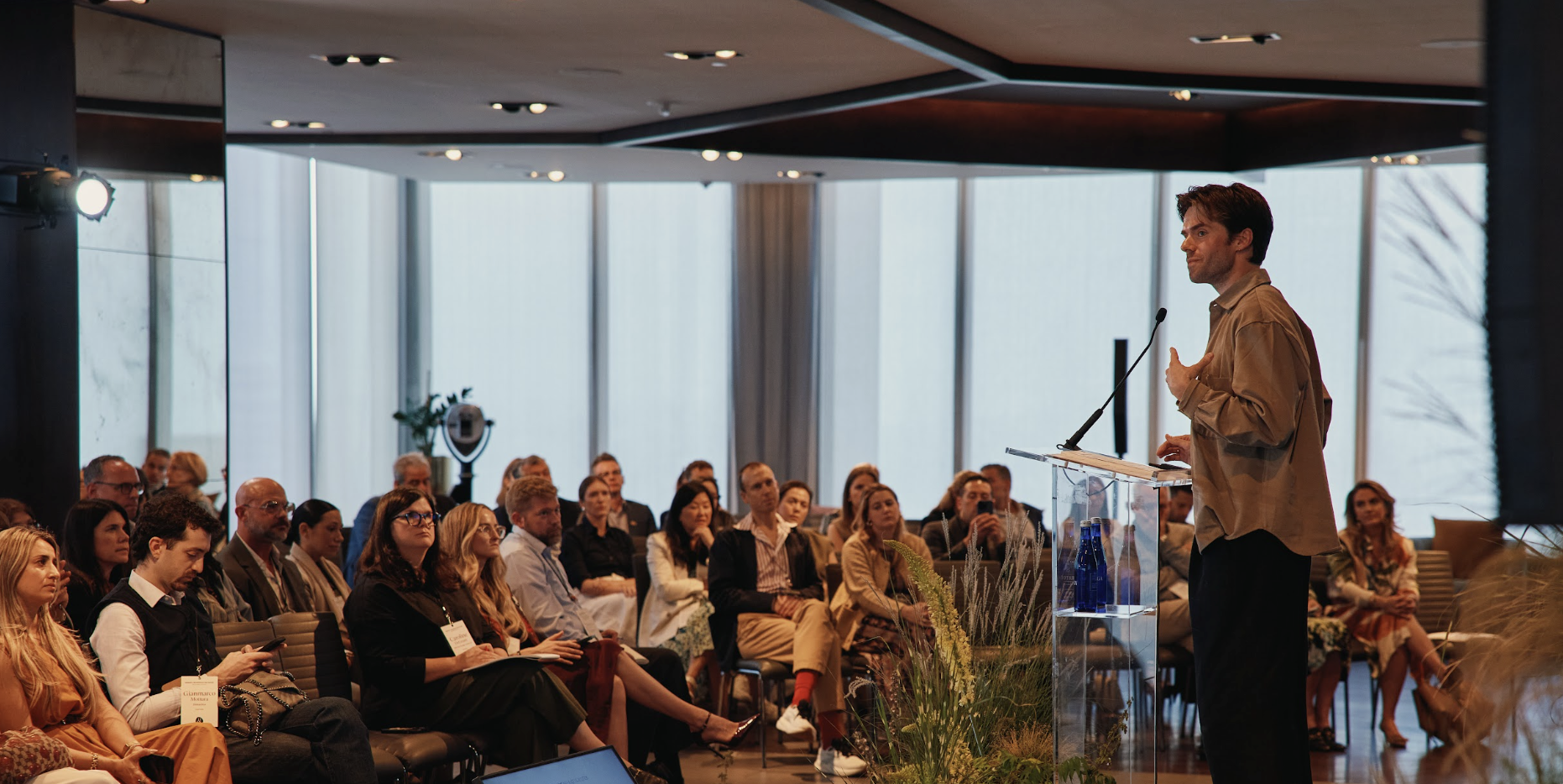
Watch the full talk here.