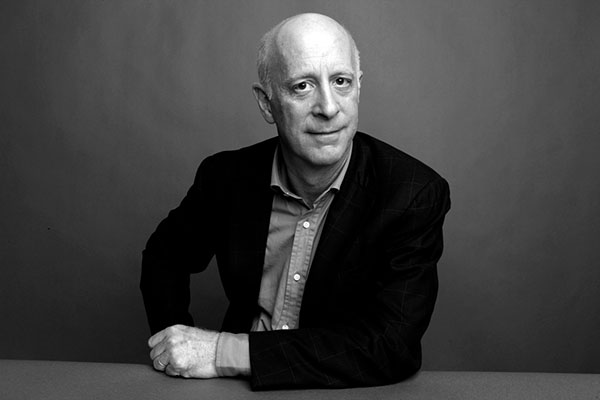
What makes for a successful modern city? That’s the question Pulitzer Prize-winning architect and Design Summit speaker Paul Goldberger looks to answer in his latest book, The Imperfect City: Design, Serendipity, and the Real Life of Cities, our November 17. In this exclusive first look, he examines how Los Angeles achieves urban vitality against all conventional patterns of city planning.
—
How is it that Los Angeles, which violates so many of the principles of urbanism that we are conditioned to admire, is nevertheless a city of such vibrancy and cultural energy? There are several reasons that Los Angeles is in every way a true city, indeed a great city, however much it doesn’t follow the traditional model; indeed, it might even be possible to say that it became a great city in part by not following the traditional model. It was never going to be a small version of New York. But like New York it had a confluence of factors, many of them happy accidents, that allowed it to grow to huge size and achieve economic might while at the same time embracing cultural and ethnic diversity. That its economy was driven in part by the entertainment industry was one of the happy accidents, since it gave the city both high visibility and a degree of allure, an aura that no other city had. Another is that Los Angeles was also a manufacturing center for the aerospace industry and the nation’s largest port. It has never relied solely on the fame of the entertainment industry to drive its economy. Size is never enough by itself, or we would look at Los Angeles’s large but bland neighbor San Diego differently. But size counts for a lot, especially when it is paired with diversity and with a powerful economy. Los Angeles was built, at least in part, by offering itself up as a new version of the American aspiration for freedom and movement. Never mind, for the moment, that time has proven that this new version exacts a high price, and that the old, dense, street-oriented model of urbanism has proven more valid over the long run than a spread-out, auto-dependent kind of city. In the years after World War II, Los Angeles held out the promise of a future that no older city could deliver: the pleasures of the suburbs combined with the energy of a new kind of city, a place where you could experience every part of the promise of postwar America.
We know, of course, that the promise of Los Angeles was illusory, and to the extent that the city was able to fulfill it at all, it was for only a few decades in mid-century. The city became more difficult, decade by decade, to live in, and the Watts riots in 1965 were a sign, even more compelling than the mounting congestion on the freeways, that all was not perfect in paradise.
But that did not diminish the strength of the city, and I’m not sure that events like the Watts riots did not embolden the city culturally. There is rarely great art produced in a frictionless environment, and as Los Angeles became a more difficult place to live in, its importance as a creator and shaper of culture only continued to grow. The city was not the paradise it claimed to be, but it was becoming something else, a city with a strong creative tension at its heart—a tension fueled, I think, by the clash between the banality of its sprawl and the beauty of its landscape, and by the growing recognition that the California dream was not turning out to be as smooth, or as easy, as it was advertised to be.
Words like “banality” and “sprawl,” however accurate they may be in describing much of Los Angeles, are misleading in another way, because they distract us from two key realities about the physical form of the city. The first is that the city is by no means entirely banal or entirely sprawling; we would be getting closer to the truth if we described it as a collection of neighborhoods that have clear and distinct physical identities. Mar Vista is not anything like Playa Vista, Beverly Hills does not look like Beverly Glen, Brentwood does not resemble Hollywood, which is nothing like Westwood. Silver Lake is completely different from Toluca Lake, and Hancock Park is not Ocean Park, which is not Echo Park.
Many of these districts are quite beautiful, almost all of them have some notable architecture, and many of them have striking topography. If we think of cities as offering more choices than other kinds of places, Los Angeles has arguably the greatest range of different kinds of places to live of any major city. There is downtown, itself a set of many different districts, from condominiums in Bunker Hill to lofts in the Arts District, and there are the newer high-rise towers of Century City and the lushly landscaped mansions of Bel Air. There are the bungalows by the seaside in Venice and the villas on the beach in Malibu and the modernist houses perched high in the hills in Hollywood and the Spanish colonial houses in Los Feliz and the wooden houses tucked deep into Laurel Canyon and Rustic Canyon, not to mention the garden apartments of the San Fernando Valley and the tall apartment buildings tightly arrayed along tsection of Wilshire Boulevard that passes through Westwood. Wilshire, which runs for almost sixteen miles from downtown to the Pacific Ocean, is as much of a central spine as Los Angeles has, and it probably comes closer to being a true linear city as anything that exists anywhere in the world.
Urban theorists have been talking about the idea of an elongated city aligned along a transportation axis for more than a century, but Wilshire did not come into being because someone thought it would be a good idea to try to realize this notion. The linear city of Wilshire Boulevard just happened. As Los Angeles expanded westward out of downtown, Wilshire became a kind of collective Main Street, attracting stores and cultural and civic and religious institutions and offices and apartments in every neighborhood along its route. No part of it has much order, other than the dense corridor formed by the apartments in Westwood, but this jumble of every which kind of building stretching out for miles through every which kind of neighborhood somehow achieves just enough coherence, if only by its buildings’ shared presence on this single boulevard. The street itself holds the pieces together, like a necklace made of clashing beads. It is not a bad metaphor for Los Angeles.
If its extraordinary variety of different kinds of places to live is one thing that lifts Los Angeles far above the banality of its strip malls and gas stations, the other thing is its natural landscape. There is plenty of it left, even though it can often seem as if every conceivable building site has been squeezed into every hillside and carved out of every canyon. It is a landscape of unusual beauty and drama for a large city, with the Pacific Ocean on one side and the Santa Monica Mountains slicing through the middle, dividing the main portion of the city from the San Fernando Valley. The estate sections in the western part of the city are lushly landscaped; the amount of green in the more prosperous sections of Los Angeles is a constant astonishment, as are the magnificent purple blossoms that fill the streets in May, when the vast array of jacaranda trees are in bloom.
And the city also possesses the enormous Griffith Park above Hollywood and Los Feliz, much of which is the most unusual kind of wilderness, a wilderness that looks onto a downtown skyline. Set within Griffith Park is one of the most famous of all Los Angeles landmarks, the Hollywood sign, the array of fifty-foot tall letters originally erected in 1923 high over Beachwood Canyon to advertise a nearby real estate development, Hollywoodland. The sign eventually came to symbolize not the private development but the public idea of Hollywood itself, its enormous white letters floating over the landscape like a film title. In 1949 the last four letters were removed, and in 1978 the entire sign, which was originally made of wood, was rebuilt with metal letters set in concrete footings. The story of the sign is the story of a temporary billboard that was an unplanned commercial intrusion into the natural landscape becoming, in effect, the permanent logo of an entire city.
The sign also reminds us that the juxtaposition of the natural and the man-made is itself a kind of leitmotif of Los Angeles, for it is so ever present, and the two are always seen in relation to each other. There are few natural places in which the man-made is not visible, and even fewer man-made places in which the natural is not visible. The wilderness of Griffith Park, the palm trees of Beverly Hills, and the strip malls and the freeways and the boulevards and the mansions and the bungalows and the car washes all have equal claim on the city’s identity. You cannot understand Los Angeles without accepting the notion that all of this coexists and that this city in a magnificent natural environment was built of equal parts respect for that nature and indifference, often hostility, to it. The indifference is not only revealed in the gas stations and strip malls; it also shows itself, more perniciously, in the way in which real estate developers devoured so much of the natural landscape, terracing hillsides to allow for easy construction of roads and large numbers of tract houses and in so doing weakening the natural ecology. Even where this mass destruction of the landscape was avoided, as in many of the residential neighborhoods in which building lots are tucked into narrow canyons and perched on the edges of high hills, the houses treat the natural landscape as something to be simultaneously celebrated and disregarded. Houses in many of the hillier parts of the city seem to be sited at random.
The city’s indifference to the landscape it professes to love is not the least of the reasons that the fires of 2025, which destroyed so much of the prosperous Pacific Palisades section on the west side of the city and of the community of Altadena on the east, were so catastrophic. Natural disasters are the ultimate unplanned events, but they can nevertheless be planned for, and Los Angeles has rarely done so adequately. California has provisions in its building codes to make structures resistant to earthquakes, for example, in the same way that states in the East require that buildings be designed to minimize damage from hurricanes. But those only apply to new construction. Many of the houses in Los Angeles that burned were decades old and built of wood and other flammable materials. And they were built in areas that are highly prone to fires—areas that arguably should not have been developed at all.
Much of Los Angeles, in other words, should probably not have happened.
It is easy to understand why it did happen, because the seductive beauty of the landscape and the climate made it hard not to want to live there, and too few people paid attention to the fact that many of the most appealing building sites were also among the most prone to fires. Here, the randomness and easy spread of the city across its remarkable natural landscape, factors that have given Los Angeles myriad attractive places to live and established so much of the city’s identity, turn out also to be destructive, even deadly. At this moment in its history the city has no choice but to engage in assertive planning and be willing to exercise its powers of regulation, since the natural order of things is not enough to protect people in certain neighborhoods from danger. Stronger building codes that require fireproof, or even fire-resistant, materials are only part of the answer, and they do not address the more urgent question: Should every section of the city that burned be rebuilt? Perhaps it would be far better for the city to allow much of the landscape to restore itself over time, and for areas that were developed unwisely to return to their natural state.
There will be more fires—that seems, tragically, to be inevitable—and while requiring buildings to be constructed of less vulnerable materials of course makes sense (and, like earthquake resistance, has been required of new construction for some time), it is only a starting point. Far more difficult will be facing the challenge of determining where to rebuild, and whether every area of the city that was destroyed should be built back just as it was. To do so would be faster and more politically expedient, but it would also deny the lessons learned. So far, unfortunately, there is every indication that the pressure to rebuild quickly is leading to the relaxation, not the tightening, of regulation. The casualness that has been so vital to the city’s character may be a luxury it cannot afford after a catastrophe. There is pressure to move quickly, and that is inconsistent with the knowledge that some of what was lost should not be replaced. A city in recovery mode after a disaster understandably wants to move quickly. But this may be one circumstance in which planning, at least as a way of setting broad parameters about where it does and does not make sense to build, is necessary. The period after the tragic loss of entire neighborhoods is not the time to count on the happy accidents that are the saving grace of urban history—though they may come, as they have come for Los Angeles so many times before.
Excerpted from THE IMPERFECT CITY by Paul Goldberger. Copyright © 2026 by Paul Goldberger. Published by arrangement with Alfred A. Knopf, an imprint of the Knopf Doubleday Publishing Group, a division of Penguin Random House, LLC.
This story is from Issue 10 of The Quarterly. Click here to see the full issue.