To see Darren onstage at The Design Summit, secure your registration here.
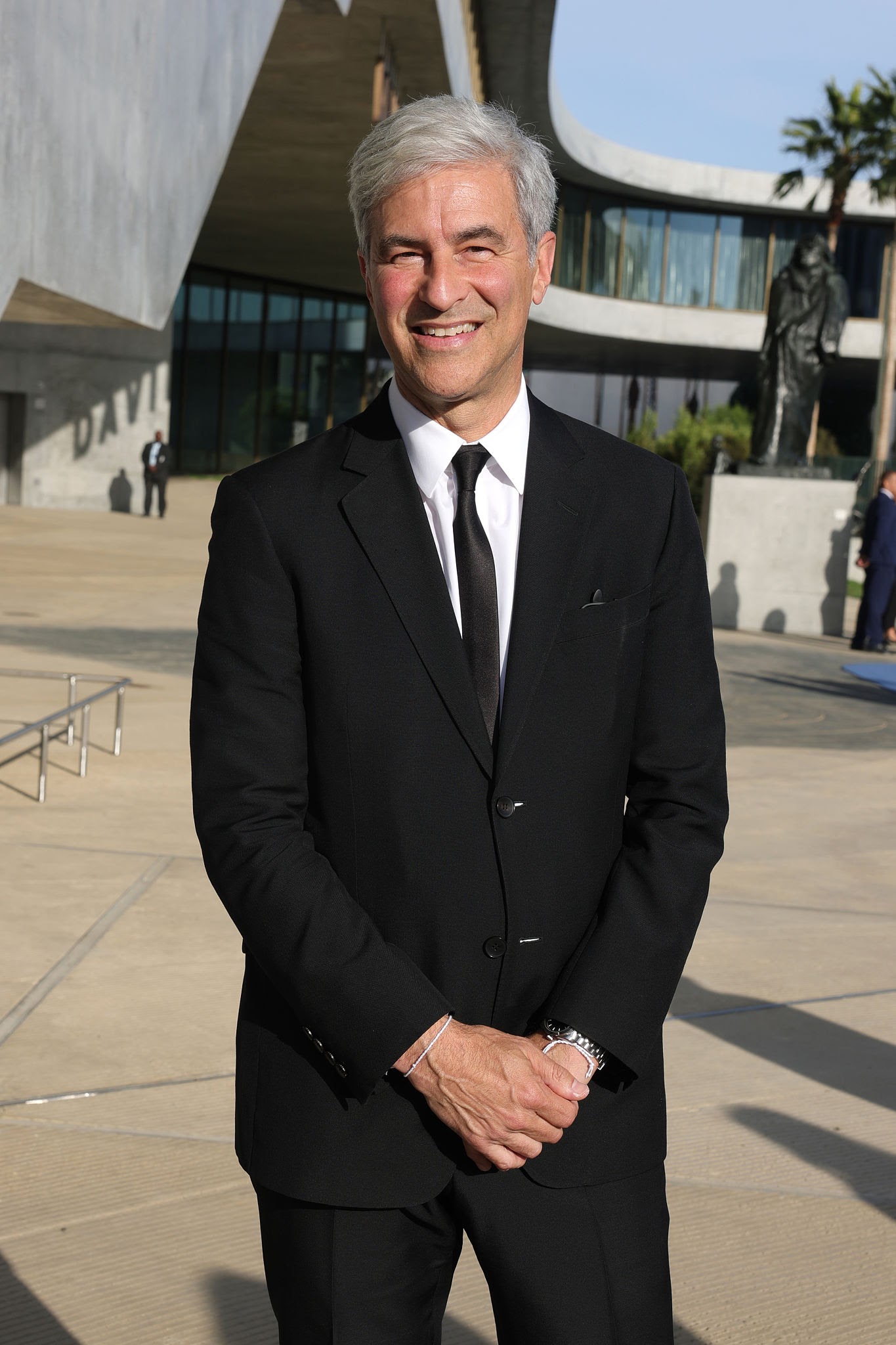
Since arriving at the Los Angeles County Museum of Art in 2006, Michael Govan has treated the institution as a piece of urban infrastructure: an opportunity to alter the way Los Angeles sees itself. His tenure has encompassed an extraordinary physical transformation of the museum, from Renzo Piano’s Broad Contemporary Art Museum and Resnick Exhibition Pavilion to Chris Burden’s Urban Light and Michael Heizer’s Levitated Mass. After two decades of planning, fundraising, construction, controversy, and delay, the Peter Zumthor-designed David Geffen Galleries opened in April 2026. The scale of the project makes his underlying mission easier to see: Michael Govan’s goal is not to preserve LACMA in stasis, but to reinvent what a museum can mean in a city that itself resists conventional categories.
The cultural leader was born in 1963 and grew up in the Washington, D.C., area. He studied art history and fine art at Williams College, graduating in 1985, and began graduate work in fine arts at the University of California, San Diego, before leaving to join the Solomon R. Guggenheim Museum. At Williams, he helped found what became MASS MoCA and served as acting curator of the Williams College Museum of Art. At the Guggenheim, where he was deputy director from 1988 to 1994, he worked across the institution’s international operations, including the development of the Frank Gehry-designed Guggenheim Bilbao.
His most consequential tenure, however, may have been at Dia Art Foundation, where he served as president and director from 1994 to 2006. There he oversaw the transformation of a former Nabisco box-printing factory in Beacon, New York, into Dia:Beacon, spurring on economic development and nearly doubling the collection size in the process.
Los Angeles offered a larger and more complicated version of the same problem. How do you make a cultural institution feel embedded in its place rather than imposed upon it? One answer was to put art outside. Burden’s Urban Light, installed in 2008, transformed a collection of salvaged street lamps into one of Los Angeles’s most recognizable public spaces. Heizer’s Levitated Mass, installed in 2012, did something even more spectacular. The 340-ton boulder became a piece of civic theater before it ever reached the museum, traveling through Los Angeles at night on a specialized transporter while crowds gathered along its route. The work generated international attention while making the journey to the museum part of the artwork itself.
Michael’s architectural collaborations followed a similar logic. Piano’s BCAM, opened in 2008, and the Resnick Pavilion, opened in 2010, added roughly 100,000 square feet of gallery space and more than doubled LACMA’s exhibition capacity before the museum undertook its larger reconstruction. The campus also became a laboratory for collaborations with architects and artists including Frank Gehry, Michael Maltzan, Fred Fisher, John Baldessari, Jorge Pardo, and Franz West.
The ultimate expression of that philosophy is the David Geffen Galleries. Designed by Peter Zumthor, the building replaces four aging structures on LACMA’s east campus with a sprawling, elevated, single-level gallery organized around movement rather than chronology. There is no prescribed route through the collection and no traditional hierarchy separating one culture or period from another. Art from across LACMA’s global holdings is intended to encounter art across time, geography, and medium.
That approach is inseparable from Michael’s larger cultural agenda. During his tenure, LACMA has dramatically expanded its collections, adding tens of thousands of works from Latin America, Asia, Africa, the Middle East, and the Pacific. Major acquisitions and gifts—including the Perenchio Collection—have helped shift the conversation about what constitutes “museum-worthy.”
It is also why his legacy cannot be reduced to the Zumthor building. The architecture is the most visible manifestation of an institutional strategy that began much earlier in his career: make the museum porous, make the campus public, bring contemporary artists into dialogue with historical collections, and make Los Angeles itself part of the museum experience. The result is a LACMA that increasingly behaves less like a conventional museum and more like Los Angeles itself: sprawling, heterogeneous, occasionally contradictory, and most interesting when different things are allowed to collide.