How William Morris’ legacy inspired the CEO of Sanderson Design Group, Lisa Montague, on the power of human craft in a digital age.

In the modern business landscape, we often hear the future framed as a binary choice: the cold precision of the algorithm or the soulful touch of the human hand. But from where I stand, that is a false dichotomy and a missed opportunity.
Running a successful business requires an artful balance of fostering innovation and lateral thinking alongside celebrating our artistic heritage. At Sanderson Design Group, we are leaning into artificial intelligence and advanced technology because they are the engines of efficiency and productivity. To ignore the leap forward that technology offers wouldn’t just be traditionalism; it would be a failure to provide our teams and our brands with the best tools available to thrive.
However, efficiency is not the soul of our business. Underpinned by our Live Beautiful strategy, preserving heritage and craftsmanship for future generations, the foundation of everything we do lies in the narrative of human intention. Craft isn’t a museum relic to be preserved in amber; it is an active, essential companion to technology, a creative response to the world around us, and a springboard for a new generation to challenge how we live.
Getting this relationship right is more than a strategic pillar. It’s about ensuring that while our processes are faster, the end result remains undeniably, beautifully crafted design that feeds the soul.
When William Morris defined the three epochs of “art workmanship” in his 1888 article, The Revival of Handicraft, he looked backward to the medieval guild and forward through the smog of the Victorian industrial age. He was a rebel fighting the soulless excesses of his time, famously repulsed by the mechanical commodities of the 1851 Great Exhibition.

We shouldn’t presume exactly what Morris would think today, but we are confident that he was the original design rebel. Were he alive now, we believe he wouldn’t be hiding in the past. We surmise that he would lead the charge into the future, immersing himself in British design and passionately advocating for human creativity and spirit.
Today, we find ourselves at the threshold of the fourth epoch. The modern threat to craft lies in the erosion of human judgment, what creative strategist Andy Harvey calls “ultra-processed creativity” or “workslop”. The environmental and existential toll of automated imagination is staggering, with data centers threatening our natural ecosystems.
However, we are optimistic. Just as Morris sparked the Arts & Crafts movement to resist the mechanical shortcuts and shallowness of the 19th century, today we coin a new movement for the 21st: Rebellious by Design.
Rebellious by Design does not reject the digital frontier; it frames craft as the essential partner to technology. Craft is an act of thinking, gesture, and judgment. As May Morris recalled of her father’s Willow Boughs design, it began with a walk by a stream, a keen observation of leaf forms, and a subjective emotional response.
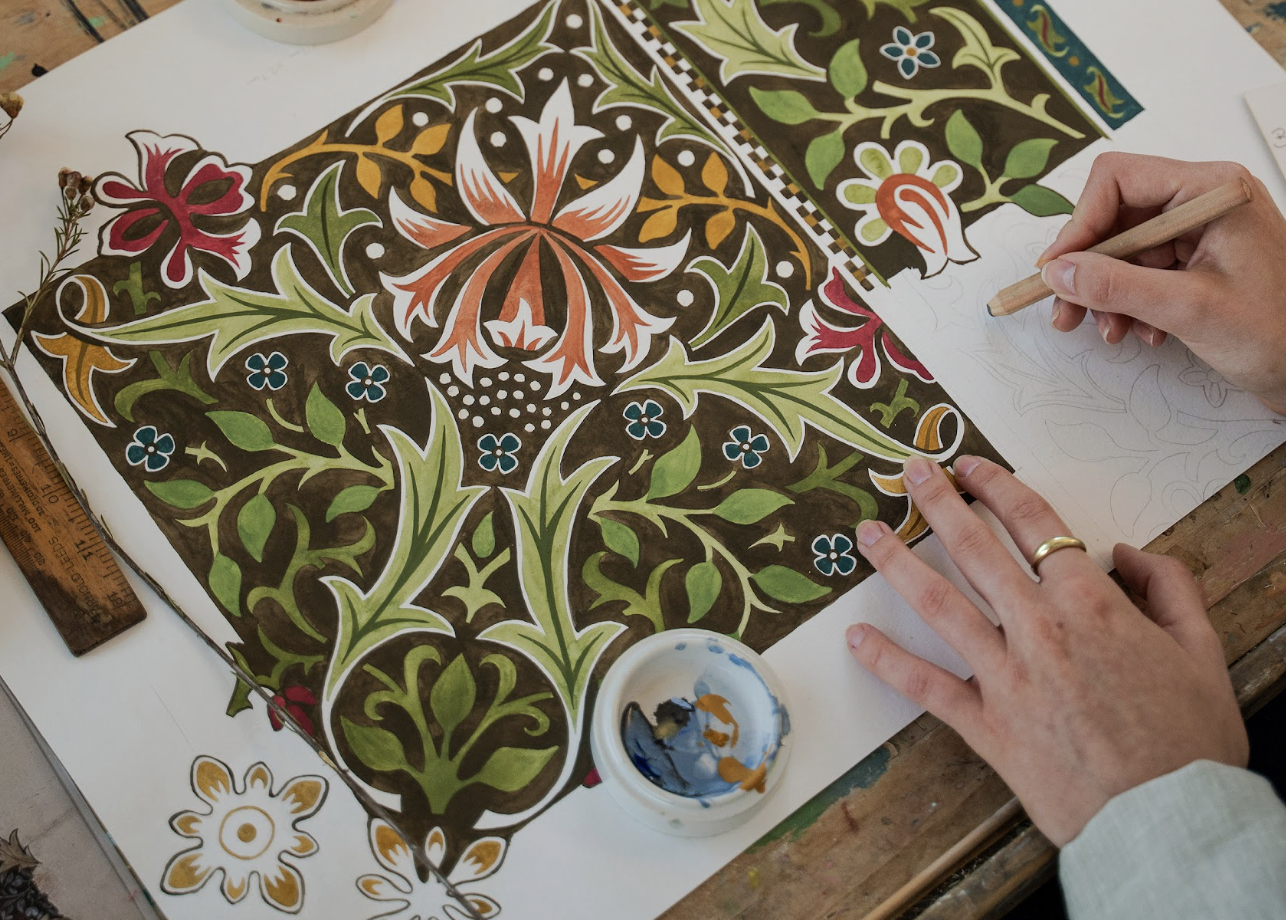
This physical connection to making remains the heartbeat of our creative process. In the historic Voysey House studio in Chiswick, a building that stands proudly as the original Sanderson wallpaper factory, our designers continue the tactile traditions of hand drawing and painting designs. They delve deep into our extensive archive to revive, renew, and rework historic patterns, motifs, and colorways for a contemporary audience.
We use technology not to replace the artist, but to span the gap between our heritage and a faster-moving world. AI can handle logistics and data, but it cannot create meaning. It cannot care. We choose the walk by the stream over the shortcut of the prompt, using advanced tools to amplify, rather than flatten, the thousands of myriad decisions that constitute a soul at work.
To champion the future of craft, we must actively invest in the ecosystem that sustains it. As Dr James Fox brilliantly chronicles in Craftland, an impassioned and inspiring account of the extraordinary men and women still doing traditional artisanal work in the face of massive technological industrialization, British making is a vital, living narrative rather than a historical footnote. At Sanderson Design Group, our commitment to this future is cemented through deep, active relationships with the cornerstones of British making, ensuring that traditional skills evolve to find relevance in modern contexts. This narrative flows from the patterns created in our studios to the meticulous craft of wallpaper making and fabric printing. These are brought to life in our British factories, Standfast & Barracks and Anstey, where designs are realized through both traditional and digital printing methods.
The true vitality of Rebellious by Design lies in the younger generations discovering the joys, frustrations, and passions of making. In a world saturated by screens, the act of physical creation is a radical, liberating act. Craft, design, art, and literature are not luxuries; they are fundamental requirements to feed the human soul.
By engaging young people in the tactile joy of creation, we aren’t just protecting heritage but are equipping a new generation with the tools to challenge the way we live and reshape our collective future.
In this fourth epoch, we can use the legacy of Sanderson Design Group and the words of William Morris as pricks of conscience. Morris himself struggled with the tensions between industry and craft; he was an imperfect guide for a complicated time, which makes him all the more relevant today.
We may not have been given a vote on the advent of this technology, but we have agency over what we do next. The Arts & Crafts movement was a resistance to the mechanization of the Victorian age. Today, we must redefine craft for our own era. We choose to make things because the act of making reminds us of our humanity, rather than seeking the most efficient path.
Our task now is to see how much we can automate where appropriate, without losing human creativity. We will always choose the walk by the stream over the shortcut of the prompt. But we must remember that Morris never objected to strolling over a bridge, provided it was well-built and led somewhere worth going. We use technology not to replace the artist, but to span the gap between our heritage and a faster-moving world, ensuring that when we reach the other side, our humanity remains intact.
This piece is an excerpt from Sanderson Design Group’s Rebellious by Design essay. To read it in full and explore the latest collections, visit: sandersondesign.group/news/rebellious-by-design
This story is from Issue 9 of The Quarterly. Click here to see the full issue.
By joining the DLN, you gain entry to the conversations, perspectives, and relationships shaping the design industry today. If you’ve found inspiration here, imagine what you’ll find inside our community.