
The David Geffen Theater will serve as the setting for The Design Summit’s general session. Register now to secure your spot.
It’s difficult to approach the David Geffen Theater without thinking in cinematic terms. This is Hollywood, after all. Plucked seemingly from a sci-fi set, the monumental concrete-and-glass sphere housing the theater serves as the striking new addition to the Academy Museum of Motion Pictures. But a set this is not. Renzo Piano and his Building Workshop designed the spherical building to express the scale, machinery, and collective wonder of moviegoing—and to hold its own while being attached to one of Los Angeles's finest surviving examples of Streamline Moderne architecture, the Saban Building.
Originally constructed as the May Company department store, the Saban Building was designed by Albert C. Martin Sr. and completed in 1939. It once anchored the western end of the Miracle Mile, a shopping district conceived for motorists rather than pedestrians. Its long horizontal lines and aerodynamic curves were meant to register through a windshield, while the gold cylinder at Wilshire and Fairfax created an unmistakable roadside marker. During the Academy Museum's restoration, more than 200,000 of its glass mosaic tiles were replaced with new pieces from Orsoni, the Italian manufacturer that supplied the originals.
Piano's Sphere Building makes no attempt to imitate the landmark beside it. Instead, the two structures turn contrast into a conversation: One is rectilinear, street-facing, and nostalgic; the other is round, sky-facing, and cutting-edge. Glass bridges connect them, preserving a clear visual break between old and new.
With newness comes some formidable engineering. The theater is supported by four massive concrete columns and is seismically isolated from the ground, an essential consideration in Los Angeles. Its bridges were also designed to tolerate the two buildings moving independently during an earthquake. Those systems, however, largely disappear from view, leaving the auditorium suspended above the Walt Disney Company Piazza with relatively little touching the ground. Above the sphere, a soaring glass dome caps the structure, shielding the open-air Dolby Family Terrace. Comprising 1,500 custom glass panels, the canopy frames views of the Hollywood Hills, while movable sunshades and operable vents help moderate the heat beneath it.
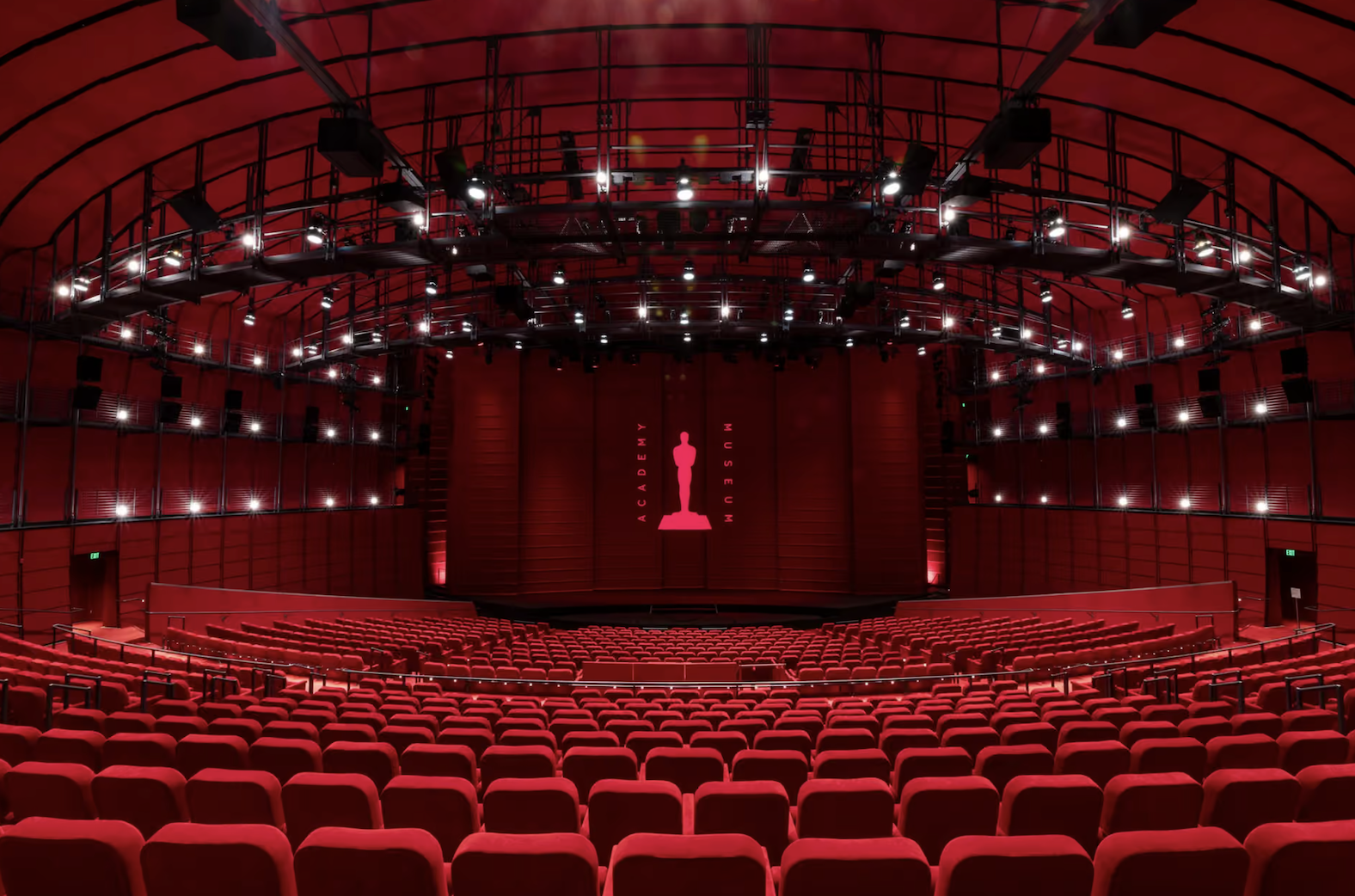
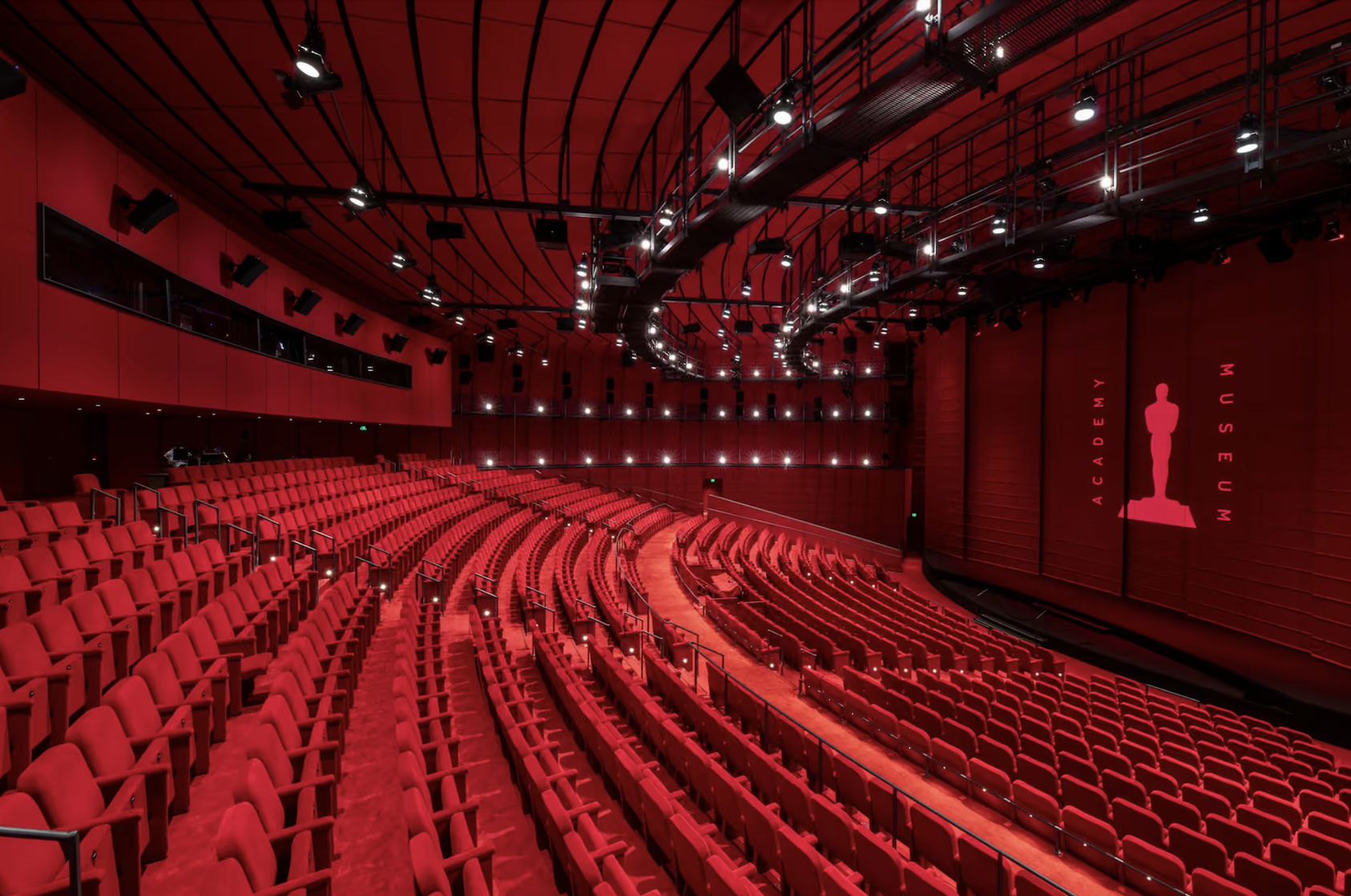
While the exterior of the David Geffen Theater impresses, the interior is just as striking: A singular red hue drenches the 945-seat auditorium, from its walls and floor to the custom Poltrona Frau seats. (Those seats, by the way, are not identical—those in the front have a more open seatback angle than those in the back, creating the optimal viewing positions across the theater's rake.) The color inevitably recalls the Academy's red carpet, but it also gives the room the enveloping quality of an Art Deco movie palace stripped of its lavish ornament.
Instead of disguising the theater's machinery, the designers made its technical apparatus visible overhead and along the walls—this space certainly honors the science aspect of the Academy of Motion Picture Arts and Sciences. It's not just for show. The theater's projection systems span much of the medium's history, accommodating nitrate, 35mm, and 70mm film, alongside 4K digital cinema, Dolby Vision, and Dolby Atmos. That last system required more than 40 surround speakers and subwoofers, installed among the overhead beams and catwalks as well as behind the curved screen. Back to that formidable engineering—the team had to isolate the auditorium acoustically from the terrace directly above it, ensuring that an event overhead would not compete with the film below.
The David Geffen Theater therefore offers more than a state-of-the-art place to watch a film. Its flexible stage, seating plan, and catwalks allow it to accommodate panel discussions and live performances, reinforcing the museum's larger point that filmmaking extends well beyond what ultimately appears on the screen. The bottom line: The theater provides an architectural close-up to the art and science of cinema.